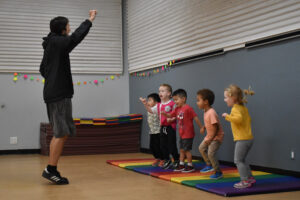

For preschoolers, play is far more than just fun, it’s the foundation of learning. Through play, children develop the skills they’ll need for the rest of their lives. Soccer offers a unique way to combine movement, social interaction, and creativity, to round out their learning process in a fun and effective way.

Play Builds Learning Skills
During the act of “play”, children are building resilience, learning to grow through trial-and-error, and developing curiosity. Research shows that learning through creative play is the ideal conditions for learning in early-childhood education. (Ginsburg, 2007).

Imagination Fuels Engagement
Research shows that when learning is fun, children are more likely to retain and recall the information. When learning is fun and connected to creativity, children are more likely to retain skills and build positive attitudes toward learning (Singer, Golinkoff, & Hirsh-Pasek, 2006).

Play Encourages Social Growth
Soccer is a team-centered sport, even in preschool formats. Through group games, children learn critical life skills, such as how to cooperate, share, and communicate (Vygotsky, 1978). Through playful adventures and games, children are learning empathy and teamwork.

Physical Play Strengthens the Body and Brain
Active play helps children build motor coordination, balance, and spatial awareness (Pellegrini & Smith, 1998). Soccer activities like dribbling, stopping, and kicking give preschoolers structured chances to refine their motor skills while also stimulating brain development that supports attention and memory.
How We Can Help
Soccer is more that a sport, it’s a playful pathway to developing essential life skills. By combining movement, imagination, and teamwork, soccer helps children thrive in body, mind, and heart. When children learn through play, they discover that learning itself can be fun.
As adults, we can cultivate that passion for learning by tapping into our own ability to “play”. By playing with our preschoolers, we are encouraging creativity and imagination. These skills lead to a lifetime of learning, growing, and fun, and that is a good thing!
References:
-
Ginsburg, K. R. (2007). The importance of play in promoting healthy child development and maintaining strong parent-child bonds. Pediatrics, 119(1), 182–191.
-
Pellegrini, A. D., & Smith, P. K. (1998). Physical activity play: The nature and function of a neglected aspect of play. Child Development, 69(3), 577–598.
-
Vygotsky, L. S. (1978). Mind in society: The development of higher psychological processes. Harvard University Press.
-
Singer, D., Golinkoff, R., & Hirsh-Pasek, K. (2006). Play = Learning: How play motivates and enhances children’s cognitive and social-emotional growth. Oxford University Press.