
July's Big Idea: Empathy
At HappyFeet, we believe soccer is more than a game. It’s a way to help children grow into kind, compassionate, and confident human beings. This month, we’re focusing on empathy—the ability to understand, feel, and respond to the feelings of others. Empathy, just like our other skills, can be practiced and developed by preschoolers. We incorporate ideas into our curriculum to provide opportunities for preschoolers to practice this important skill.
What Is Empathy?
Empathy is the ability to understand and share the feelings of others. In a recent study by Poline Simon and Nathalie Nader-Grosbois (2021), they dive into the development of empathy in children ages 3 to 6. Their research gives us valuable insights into how empathy evolves and how every child may experience it differently. This study breaks empathy down into three different parts, affective, cognitive, and behavioral.
Affective empathy – Feeling what someone else feels.
Cognitive empathy – Understanding why someone feels that way.
Behavioral empathy – Taking action to help or comfort others.
These different aspects grow at different rates, and children may show strength in one area and need support in another.
What Empathy Looks Like in Preschoolers
Preschoolers are just beginning to understand empathy. As they grow, so does their ability to recognize emotions in others and respond with care. While their expressions may be simple or inconsistent, they lay the foundation for strong social and emotional skills.
Noticing Emotions: Young children often point out when someone is sad or upset—an early sign of emotional awareness.
Talking About Feelings: They begin to use words like happy, mad, or scared, showing an emerging understanding of emotions.
Comforting Others: Preschoolers may offer a toy, give a hug, or say “It’s okay” when someone is upset.
Sharing and Taking Turns: Empathy helps children consider others’ feelings, which supports fairness and teamwork—especially in group play like soccer.
Empathy is still developing at this age, and responses won’t always be perfect. But with support, modeling, and practice, empathy continues to grow.
How We Encourage Empathy In Class
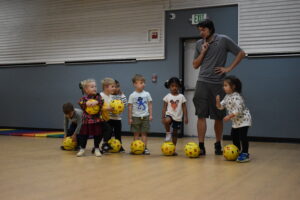
This month, our classes focus on creating conversations around feelings. During our adventures, coaches will pause to explore how characters—like Bob, the villain, or an animal—might feel in different situations. These moments help children practice naming emotions and recognizing them in others.
Coaches also use real-life moments to spark these conversations. If a HappyFeeter feels sad, we acknowledge and share that feeling. By modeling empathy, our coaches lead by example and help children build emotional awareness in a meaningful, playful way.
Citations:
Simon, P., & Nader-Grosbois, N. (2021). Empathy in Preschoolers: Exploring Profiles and Age- and Gender-Related Differences. Frontiers in Psychology, 12, 782500. https://doi.org/10.3389/fpsyg.2021.782500